info@hmvcg-cic.org.uk
info@hmvcg-cic.org.uk
About the project
SPACE (Social Prescribing and Civic Engagement) combines social prescribing and volunteering to enhance the health and well-being of individuals with health and rehabilitation needs. The project will also address the education and training needs of healthcare, social care and rehabilitation professionals working in the field.
By fostering transnational collaboration and knowledge exchange, SPACE aims to improve practices, increase quality, and create new opportunities for organisations involved in social prescribing. This will drive transformation and innovation at both practice and policy levels, particularly in the context of cancer care.
Objectives
To Co-produce with interested stakeholders a suitable approach for implementing and integrating volunteering as part of Social Prescribing;
To Raise the capacity and confidence of health, social care and rehabilitation professionals as well as CSO/ NGO staff and volunteers to engage with the Social Prescribing programme in the context of volunteering;
To increase the interest and awareness of the value of volunteering in Urban/Community gardens as part of Social Prescribing schemes.
EU Cancer Mission
SPACE puts a special focus on cancer care. For cancer survivors, social prescribing can be especially helpful as it can support and improve their mental health, social isolation, and the need for a sense of purpose after treatment.
By raising the awareness on the benefits of social prescribing and volunteer programs, SPACE aims to strengthen cancer care in primary healthcare systems throughout Europe.
Social prescribing is an approach to health and wellbeing that recognises something very simple but often overlooked: we are social beings, and our health is shaped not just by biology, but by our relationships, environment and daily lives. While medication and clinical treatments are vital, they are not always the full answer. Social prescribing exists to bridge that gap.
Traditionally, when we feel unwell, we visit our GP, describe our symptoms and leave with a prescription. This model is effective for many conditions, but it can also leave people feeling disempowered, unheard, or stuck on long-term medication without addressing the root causes of their difficulties. Social prescribing looks beyond symptoms to explore what is really going on in someone’s life and how that might be affecting their health.
Through social prescribing, people can be referred to a social prescriber based in their GP practice or primary care network[1]. Social prescribers have longer, ongoing conversations with individuals and work with them over time. Rather than a one-off appointment, they carry a caseload and provide continuity, helping people identify social, community-based or nature-based activities that could support their wellbeing, recovery or rehabilitation.
Many GP appointments are not driven by clinical need alone. NHS data shows that over 30% of appointments relate to issues such as loneliness, low mood, unemployment, poor diet, stress or social isolation. These challenges are very real, but they often cannot be solved by medication alone. Social prescribing offers practical, personalised alternatives that sit alongside medical care.
One important area of social prescribing is green and blue prescribing. This involves connecting people with activities in natural environments – such as parks, rivers, woodlands and gardens – to support both physical and mental health. Evidence shows that spending time in nature can reduce stress, improve mood, build physical strength and support recovery from illness. Activities might include volunteering in local green spaces, gardening, walking groups, outdoor exercise, or creative and social activities held outdoors. See below image for more ideas.
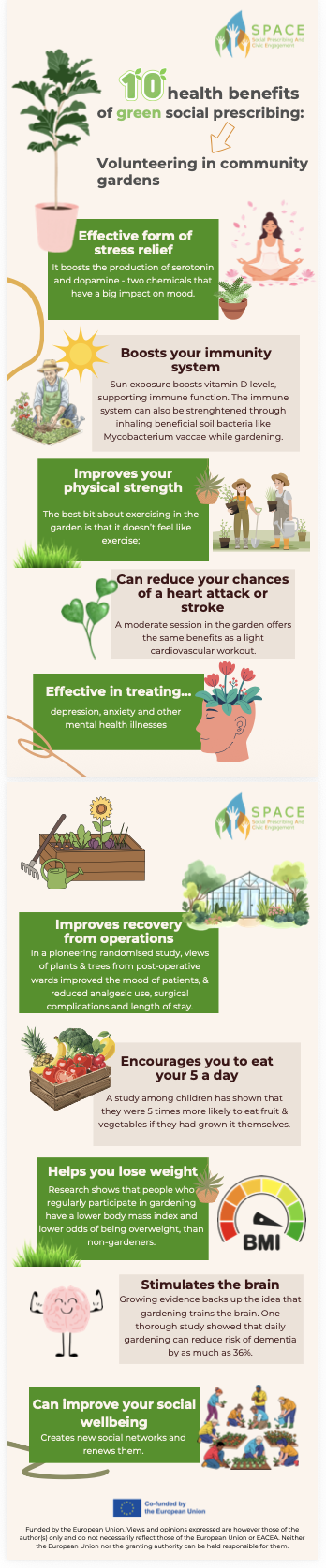
Green and blue prescribing delivers what is often described as a “double return on investment”. People benefit directly through improved wellbeing, confidence and social connection. At the same time, these activities support the natural environment. Individuals who engage in green prescribing often become more environmentally aware and more likely to adopt positive behaviours such as recycling, protecting wildlife or improving local biodiversity. Small personal actions – like creating hedgehog pathways between gardens – can add up to meaningful change.
Social prescribing is particularly valuable for people living with long-term conditions or those recovering from serious illness. For example, cancer rehabilitation, which is why HMVCG’s involvement in the SPACE project is so important! After treatment such as chemotherapy or radiotherapy, many people experience fatigue, muscle weakness, emotional distress and a loss of identity beyond their illness. Green and blue prescribing can help people gradually rebuild strength, energy and confidence, while also reconnecting socially. These activities shift the focus away from illness alone and help people rediscover themselves as individuals within a community.
Another area where social prescribing has shown strong impact is in dementia care, while there is no cure, social connection is critical. Loneliness and isolation are known to accelerate cognitive decline. Connecting people with dementia to peer groups, community activities and shared experiences can slow progression, improve quality of life and provide vital support for carers. Supporting carers is equally important, as they are at high risk of exhaustion and burnout. When both patients and carers are supported, outcomes improve for everyone.
Social prescribing also helps break down silos within health and care systems. Instead of isolated professionals working separately, it encourages communities of practice that bring together clinicians, social prescribers, community organisations and voluntary groups. This collaborative approach allows different types of expertise to work together, identifying solutions that a single specialist might not see on their own.
So why should you be interested in social prescribing? Because it empowers you. It gives you permission to ask different questions when you visit your GP, such as: “Are there non-medical options that could help me?” or “Can I speak to a social prescriber?” It recognises that health is shaped by where and how we live, not just by medication.
You don’t always need a referral to get involved. Many green and social prescribing activities allow self-referral, and local voluntary and community organisations can help you explore what’s available in your area. Whether it’s volunteering, gardening, creative activity or simply spending time outdoors with others, social prescribing opens up new ways to support your wellbeing.
Contact HMVCG info@hmvcg-cic.org.uk to find out what’s being organised in Heaton Mersey or to be added to our mailing list so you don’t miss out on the opportunity to get involved, and improve your own wellbeing too!
In short, social prescribing complements medical care by addressing the social and environmental factors that influence health. It’s personalised, holistic and grounded in real life – helping people not just to manage illness, but to live well.
[1] Heaton Mersey is part of a Primary Care Network with Heaton Moor, serving around 30,000–50,000 patients. Some services are shared across practices, so you may be asked to visit Heaton Moor. Social prescribers may also be called community navigators or connectors.
An Interview between Jo Ward and Susan Arslan, about HMVCG’s Role in the SPACE Project
Jo: Absolutely! SPACE stands for Social Prescribing and Civic Engagement, and it’s a really exciting ERASMUS+ initiative. Back in January 2024, Heaton Mersey Village Conservation Group C.I.C.—HMVCG—was invited to join a European bid writing team. The goal? To secure funding for a project that brings together two powerful forces: green social prescribing and volunteering. It’s about helping people connect with nature to boost both their wellbeing and the environment.
Jo: It really was a natural step for us. HMVCG has always been about preserving and enhancing green spaces through volunteer-led action. So, a project focused on public engagement with nature, improving community health, and boosting environmental wellbeing? That ticks every box for us. We’ve always believed that the best way to create a sustainable future is by working together—and this project embodies that ethos.
Interview conducted on 1 August 2025
* Sue and Jo are Directors of HMVCG C.I.C.
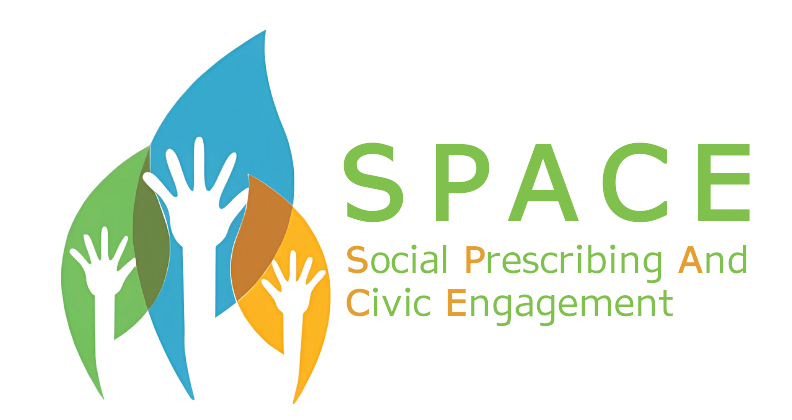
Jo: Thank you! Yes, we were thrilled when the bid was approved. HMVCG is leading the UK side of the project, working with fantastic partners from Brussels, Spain, Greece, Southern Ireland and Malta. We’re also collaborating with professionals from medicine, green prescribing and volunteering sectors here in the UK. It’s a truly cross-sector, cross-country effort.
Jo: Green social prescribing—sometimes called the Natural Health Service here in the UK—is about connecting people to nature-based activities to support their physical and mental health. That might mean guided walks, community gardening, conservation volunteering, or simply spending time in parks or by rivers. The evidence is growing that green and blue spaces—think woodlands, canals, wetlands—are vital not just for ecosystem health, but for human health too.
Jo: Yes, that’s an important part of it. With cancer diagnosis rates now at 1 in 2 in the UK, we saw an opportunity to explore how green prescribing can play a role in recovery and rehabilitation. Whether it’s reducing stress, supporting physical activity, or rebuilding confidence, nature can be a powerful ally for people living with and beyond cancer.
Jo: Simply put, it’s to get more people using and caring for green and blue spaces—for their own health and for the benefit of nature. We want to raise awareness, build engagement, and secure investment to improve the quality and reach of green prescribing. And of course, we’re focused on demonstrating the real, measurable value of this work.
Jo: We’re coming to the end of the first stage this August. We’ve been carrying out a UK and EU-wide scoping exercise, and we’re publishing a report that includes:
Jo: The report is just the beginning! We’ll be using its findings to shape the next phase of the project. So, keep an eye on our website and social media—there’s so much more to come. As we like to say: watch this SPACE.
We need your consent to load the translations
We use a third-party service to translate the website content that may collect data about your activity. Please review the details in the privacy policy and accept the service to view the translations.